How Do You Know If a Tree Is Dangerous?
A tree usually warns you before it fails. Here are the six signs we check on every property, what each one means, and when a tree stops being a wait-and-see problem.
3 min readRooster Tree - Lawn Services
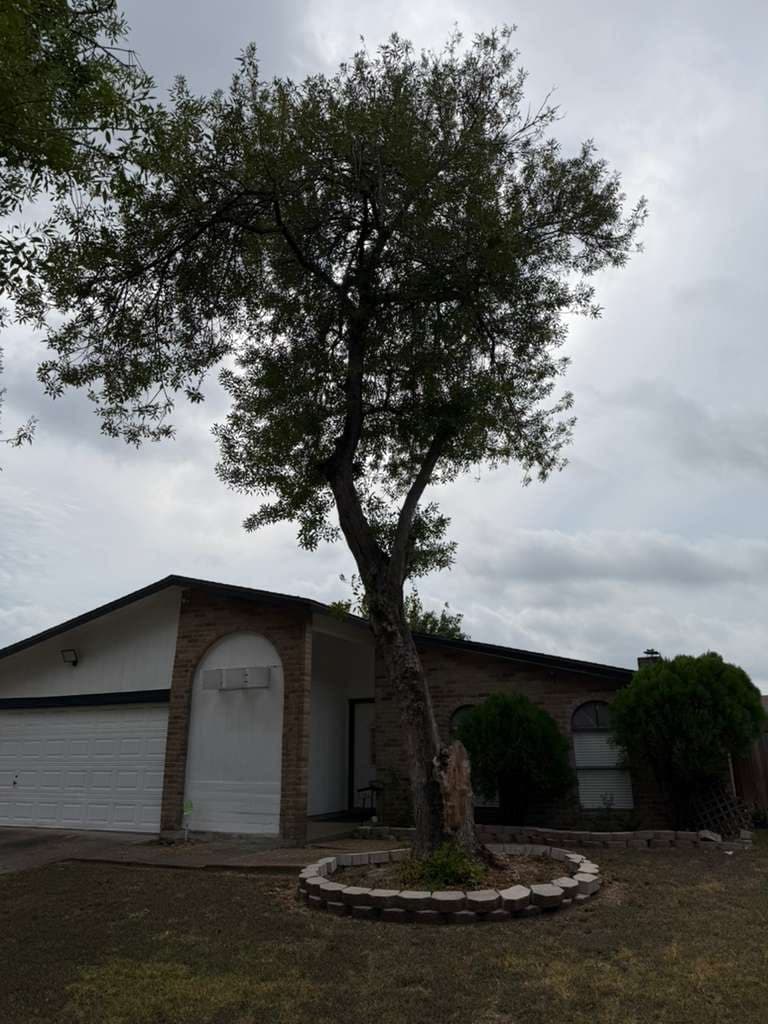
Most trees that fail give you warning first. The problem is that the warnings are easy to miss, and the ones that matter most are not in the canopy where everybody looks — they are at the trunk and the base.
Here is what we actually check when we walk a property, in the order we check it.
1. Look at the trunk first
The trunk carries everything above it, so this is where a problem is most expensive to ignore. Walk the full circle of the tree and look for:
- Splits and deep vertical cracks, especially where the trunk forks
- Hollows or cavities — put a hand in if you can reach; healthy wood is firm, failing wood crumbles
- Missing bark in patches, with no new growth around the edge
- Soft or spongy wood anywhere along the lower trunk
A tree can carry a full green canopy while the trunk underneath it is hollow. That is the single most common thing homeowners are surprised by.
2. Check the base and the soil
Look down. Two things matter here:
Fungus. Mushrooms or shelf fungus growing at the base of the trunk are feeding on wood that is already breaking down. It is a symptom, not the cause, and the cause is usually rot in the roots or the lower trunk.
Disturbed soil. If the ground on one side of the tree is cracked, lifting or mounded, the root plate is moving. That is one of the clearest signals you can get, and it is the one that most often shows up shortly before a tree goes over.
3. Judge the lean — and whether it is new
A lean by itself is not an emergency. Trees lean toward light, away from buildings, and away from prevailing wind, and many have done so safely for decades.
What matters is change. Compare the tree against something fixed — a fence line, a roof edge, an old photo on your phone. If the lean is new, or if it increased after a storm, treat it as urgent rather than something to watch.
4. Scan the canopy for deadwood
Now look up:
- Bare limbs with no leaves during the growing season
- Hangers — limbs that have already snapped and are caught in the branches above, waiting for wind
- Branches growing over a roof, a driveway, a fence or a power line
A hanger is the one to act on quickly. It has already failed; the only question left is where it lands.
5. Note what is underneath
This is the step people skip, and it is the one that sets the priority.
The exact same defect is a routine job over an open back lawn and a serious problem over a bedroom, a car or a walkway. Before you call anyone, write down what a failure would land on. It changes the answer more than the defect itself does.
6. Get it looked at before it decides for you
If you found any of the above, send us what you have. Photos help a lot — one of the whole tree, one of the trunk, one of the base.
We give a free estimate before any work starts, and if what you are looking at is an active hazard, we do not make you wait for business hours.
When it is already an emergency
Our regular hours are 7:00 AM to 7:00 PM. Tree emergencies are the exception, and they are covered 24/7:
- A tree or large limb already down
- Storm damage
- A limb hanging over a roof, a car or a walkway
- Any tree that has visibly moved
Call (832) 989-8795 — any hour, day or night.
For everything else, from tree trimming and removal to stump grinding, we work regular hours and start with a free estimate.
Common Questions
Frequently Asked Questions
Does a leaning tree always have to come down?
No. Plenty of trees have leaned for years and are perfectly stable. What matters is whether the lean is new or getting worse, and whether the soil at the base is lifting. A long-standing lean on solid ground is usually fine; a lean that changed after a storm is not.
Can a tree be dangerous if it still looks green and healthy?
Yes. Decay works from the inside out, so a tree can carry a full green canopy while the trunk underneath is hollow. That is why we look at the trunk and the base first, not the leaves.
Do you remove the stump as well?
Yes. Stump grinding is part of what we do, and we would rather grind it out than leave you with a stump to mow around. We haul the debris off too, so the yard is left level.
What if a tree comes down at night or during a storm?
Call us. Our regular hours are 7:00 AM to 7:00 PM, but tree emergencies are the exception — storm damage, fallen trees and dangerous branches are covered 24/7.